Jagdish Whitten was 25 and out for a run in San Francisco in July 2023 when a car hit him crossing a busy street. He described doing “a little flip” over the vehicle and landing in the road, then getting himself to the curb. Onlookers called an ambulance. Whitten waved it off and had friends drive him to the Helen Diller Medical Center instead. “I knew that ambulances were expensive, and I didn’t think I was going to die,” he said.
He was right about the price. He was wrong about who would decide. Doctors treated him for a mild concussion, a broken toe, and bruises. Then, with an IV in his arm and a neck brace around his throat, they told him a traumatic injury had to go to the city’s only Level 1 trauma center. An AMR ambulance drove him six miles to Zuckerberg San Francisco General Hospital. Emergency room doctors there checked him over, told him he had already received appropriate treatment, and released him.
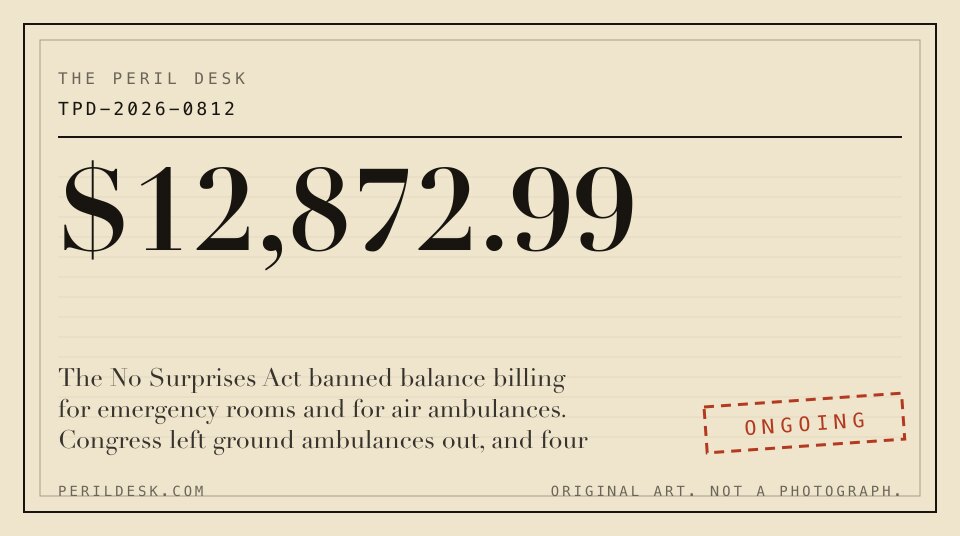
The bill was $12,872.99.
Four line items for six miles
Base rate, $11,670.11. Mileage, $737.16. EKG monitoring, $314.45. Infection control, $151.27. Those figures are not ours. They were published by KFF Health News on February 28, 2025, in a Bill of the Month investigation reported by Sandy West and co-published with The Washington Post. Every detail about the Whitten family in this file comes from that reporting. We did not contact them, and this desk does not go looking for private medical bills that a family has not already chosen to make public.
Here is the verdict, and the ambulance industry is welcome to dispute it. Congress banned this exact category of bill in December 2020 and then wrote in an exception covering the one ride in American medicine that nobody gets to shop for. The exception is not an oversight anymore. It has now survived a federal advisory committee, a unanimous recommendation, and five and a half years.
The word missing from the fact sheet
CMS publishes a plain-English fact sheet on the No Surprises Act. Its opening sentence says the law protects people covered under group and individual health plans “from receiving surprise medical bills when they receive most emergency services, non-emergency services from out-of-network providers at in-network facilities, and services from out-of-network air ambulance service providers.”
Air. Read the list again and count what is not on it. A helicopter is covered. The van that drives you six miles across San Francisco is not.
KFF Health News reported the reason in July 2025. Federal lawmakers punted on ground ambulances in part because the business models run from private national companies to volunteer fire departments, and in part because there was little data on what the rides actually cost.
Anthem said the ambulance needed pre-authorization
Whitten was insured under his father’s employer-sponsored plan from Anthem Blue Cross. The bill arrived months after the ride. He photographed it and sent it to his dad. Anthem denied the claim, saying the ambulance was out of network and required pre-authorization.
“It didn’t make a whole lot of sense to me, because the doctor is the one who put him in the ambulance,” Brian Whitten said. “It’s not like somehow he just decided, ‘Hey, can I take an ambulance ride?’”
Brian Whitten filed an appeal on his son’s behalf. Anthem granted it and paid AMR $9,966.60. Michael Bowman, an Anthem spokesperson, said AMR had not submitted all the information the insurer required to process the claim, which is what produced the first denial. The successful appeal still left $2,906.39 sitting on the family.
He called AMR several times about the rest. He never reached a human being. “I couldn’t find a way to talk to somebody about this bill other than how to pay it, and I didn’t want to pay it,” he said. In January 2024 he paid it anyway, worried the account would go to a collection agency and take his son’s credit with it.
That October he was going through his credit card statements and found that AMR had refunded the entire payment. Nobody had called to tell him. Suzie Robinson, AMR’s vice president of revenue cycle management, said the company’s third-party billing agency runs regular accuracy audits, and that an audit of Jagdish Whitten’s bill “revealed that the care provided did not meet the criteria for critical care,” which is what prompted the refund. Robinson said those audits indicate fewer than 1% of the company’s 4 million medical encounters a year are billed incorrectly.
Fewer than one percent of four million still leaves room for forty thousand.
Half of every emergency ride in the country
One family is an anecdote until somebody supplies the denominator. The Peterson-KFF Health System Tracker supplied it on June 24, 2021, using 2018 large-employer claims data covering 18 million people. About half of emergency ground ambulance rides, 51%, included an out-of-network charge for ambulance-related services. Non-emergency rides ran 39%. As many as 1.5 million privately insured patients brought to an emergency room by ambulance may be at risk of a surprise bill every year.
In seven states, more than two-thirds of emergency ground ambulance rides carried an out-of-network charge. Washington, California, Florida, Colorado, Texas, Illinois, Wisconsin. Whitten was hit by a car in the second of those. The same analysis found local fire departments and other government agencies provide 62% of emergency ground ambulance rides, which is the awkward fact underneath every attempt to regulate this. The out-of-network provider billing you is often your own city.
The committee met three times and then stopped
Congress did not do nothing. Congress ordered a study. The No Surprises Act required the Secretaries of Health and Human Services, Labor, and the Treasury to convene an advisory committee on ground ambulance and patient billing. The charter was signed by the HHS Secretary on November 16, 2021. Members were announced in a Federal Register notice on December 13, 2022. The committee held three public meetings between May 2 and November 1, 2023.
We pulled its report from cms.gov on August 12, 2026. It is a long document with five chapters and a stack of appendices, and on the central question it does not hedge.
The Committee was unanimous on the need to take consumers who have health coverage for emergency services (covered individuals) out of the middle of ground ambulance emergency service billing disputes between ground ambulance providers/suppliers and insurance companies and group health plans (payors).
The recommendations were delivered on August 28, 2024. They include mandatory coverage of emergency ground ambulance services wherever a plan covers emergency services at all, a prohibition on balance billing, a fixed dollar cap on cost sharing that applies before the deductible, and coverage of emergency interfacility transports, which is precisely the ride Whitten took. Table 1 of the report lists sixteen states that had already passed ground ambulance balance-billing protections as of March 2024. CMS’s consumer fact sheet, still live today, still lists air ambulance providers and no others.
Colorado passed it unanimously and it died anyway
The states kept going. KFF Health News reported on July 9, 2025, in a piece by Rae Ellen Bichell and Katheryn Houghton co-published with NPR, that Utah and North Dakota joined 18 other states with protections that year. California’s own law on surprise ambulance billing, AB 716, took effect on January 1, 2024. Whitten’s ride was in July 2023, about five months too early.
Colorado tried to extend its protections to public ambulance services and to hospital-to-hospital transfers. The measure passed both legislative chambers unanimously. Governor Jared Polis vetoed it, citing the fear of rising premiums. According to Colorado secretary of state data cited in that reporting, the only lobbying groups registered as opposing the bill were Anthem and UnitedHealth Group, plus the UnitedHealth subsidiaries Optum and UnitedHealthcare. Kevin McFatridge of the Colorado Association of Health Plans wrote to the governor requesting the veto, with an estimate that the bill would raise premiums by 0.4%. In Montana, legislators considered setting a minimum reimbursement at 400% of the Medicare rate. Insurers lobbied it down.
Even fifty perfect state laws would miss most working Americans. State insurance law reaches state-regulated plans only. KFF’s 2024 Employer Health Benefits Survey found that 63% of covered workers are enrolled in self-funded plans, which are governed by federal ERISA rules and sit outside state authority. Whitten’s father’s coverage was employer-sponsored.
“It’s why we need a federal ambulance protection law, even if we passed 50 state laws,” said Patricia Kelmar, who directs health care campaigns at PIRG and sat on the federal advisory committee. On the Whitten refund, she was blunter. “It’s amazing that he got his money back. That’s what’s shocking.”
Currently Inactive
Jagdish Whitten got his $2,906.39 back because a billing contractor audited itself and found it had charged for critical care that was not delivered. That is the whole mechanism of his rescue. No statute, no regulator, no appeal right. An audit, and a refund he discovered on a credit card statement four months before anyone told him.
The report is still posted on the CMS website, under a heading that reads Committee Activity. The page was last modified on March 13, 2026. Directly above the link to the PDF sits a line labeled Committee Status. It reads Currently Inactive.