The page is called Mitigation Resources. It sits at the bottom of the Consumers menu on the Colorado FAIR Plan’s website, below Eligibility and below Find an Agent, and on August 4, 2026 it named the vendor and the model behind Colorado’s insurer of last resort. No statute required it to.
“The Colorado FAIR Plan uses a property-specific wildfire risk model from ZestyAI, Z-FIRE, to evaluate wildfire risk for each insured property,” it reads. “Z-FIRE provides two risk scores. The Level 1 score is a community-level score; the Level 2 score is a property-level score. Each score is on a scale of 1-10, with 1 being the lowest risk and 10 being the highest.”
Three sentences later the same page says the FAIR Plan “does not provide discounts for individual mitigation actions taken; however, verified changes that materially affect wildfire risk may be considered as part of the FAIR Plan’s rating process.”
The legislature names the machine
Both passages are on that page because of one statute. House Bill 25-1182 was signed by Governor Jared Polis on May 28, 2025 and took effect July 1, 2026. It added section 10-4-124 to the Colorado Revised Statutes. A legislature wrote it. It is not a regulator’s bulletin, and it names the thing directly.
The trigger is wide. Any insurer that provides a mitigation discount, or that uses a wildfire risk model or risk score to underwrite, nonrenew, price, create a rate differential, or surcharge a premium, must send an annual written notice. The notice has to carry the wildfire risk score, any other wildfire risk classification used, and the applicable mitigation discounts. It also has to carry the range of scores the property could have received, where in that range the property landed, a written explanation identifying the primary features that drove the assignment, and what each mitigation action could do to the number.
The clocks are specific. An applicant gets the score no later than fifteen days after a completed application, and a policyholder gets it in the renewal offer, or in the nonrenewal notice if the policy is being dropped. A policyholder who completes mitigation and asks for a rescore gets an answer within thirty days. An appeal must be acknowledged in writing within ten calendar days and decided in writing within thirty.
The act closes the file it opens
Subsection (2) requires insurers to hand the commissioner the model itself, a description of it, its impact on rates, an actuarial justification for every rating factor including mitigation discounts, and an explanation of how it gets used in underwriting. Nothing else in the section asks an insurer for that much. It runs one direction.
Models submitted to the commissioner pursuant to this section shall be treated as trade secrets and not subject to disclosure under the “Colorado Open Records Act”, part 2 of article 72 of title 24.
So the arithmetic goes into a filing cabinet at 1560 Broadway and stops. A homeowner gets a number, a range, a position in that range, and the top features that moved it. Nobody outside the Division gets the weights. The FAIR Plan’s own page goes further than the statute requires, because it names its vendor.
The Division moves the date
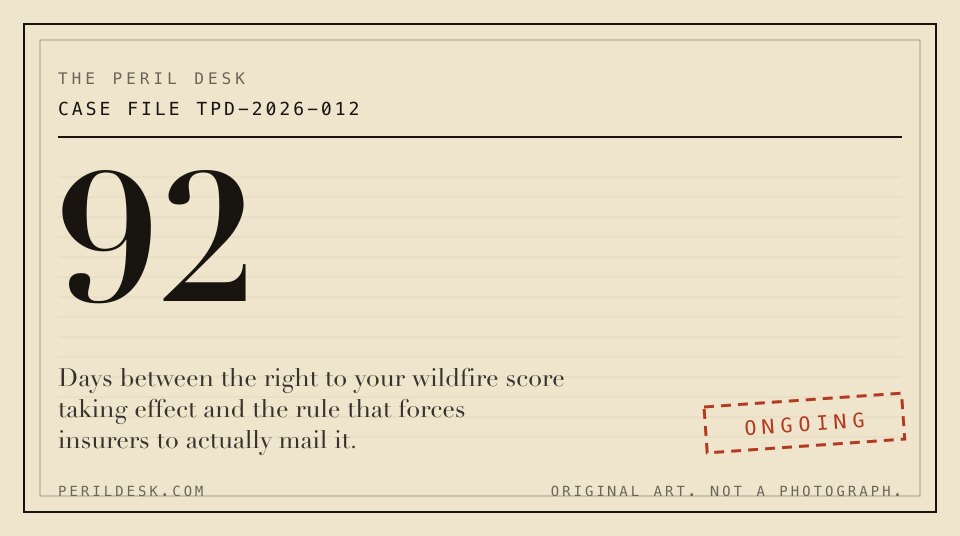
The law took effect July 1, 2026. Regulation 5-1-28, adopted under 3 CCR 702-5, is listed on the Division of Insurance’s own “Regulations Adopted But Not Yet Effective” page with an effective date of October 1, 2026. That is 92 days.
The draft the Division posted set its own effective date at February 14, 2026, four and a half months before the statute. The adopted version moved it to October 1, 2026, three months after.
Section 5.D of the adopted rule is explicit about what happens in between. The notice required by 10-4-124(6)(a) and (b) “shall be sent with new policies effective, and renewal policy offers sent to the policyholder, on or after October 1, 2026.” The act itself does not wait. Section 2 of the act applies it “to property insurance policies issued or renewed on or after the applicable effective date.” A Colorado homeowner whose policy renewed in July or August 2026 has a statutory right that arrived before the operational instruction for delivering it.
The rule also lost a word on the way to adoption. The draft version posted by the Division said an insurer’s public website must identify property-specific mitigation actions and that “the amount of discount, type of incentive or other premium adjustment must be clearly identified.” The adopted Section 5.B.1 instead says the website “shall identify the types or categories” of actions and “describe the potential range or maximum level of such discounts or incentives, where applicable.” Amounts became categories and ranges. The statute at 10-4-124(5)(b) still says the website shall identify the amount associated with each action.
State Farm publishes a range
On August 4, 2026 The Peril Desk checked the public homeowner discount page at statefarm.com for the Colorado block. It exists, and it carries numbers. Community level, for policies inside an NFPA Firewise USA recognized site: 2% to 5%. Property level, for policies meeting the IBHS Wildfire Prepared Home or Wildfire Prepared Home Plus standard: 4% to 18%. The block covers Homeowners, Rental Dwelling and Farm or Ranch policies. Both figures are stated as discounts “off of the wildfire portion of the premium.” The page does not say what fraction of a Colorado premium the wildfire portion is.
The appeal route is published and electronic, which is what Section 5.G will require in October: “If you disagree with the information on file for your property, you have the right to appeal.” Policyholders are told to contact an agent or write to wildfireappeals@statefarm.com. The page does not state the ten-day acknowledgment or the thirty-day decision.
It also lists exclusions. Wildfire mitigation discounts are not available for Renters, Condominium Unitowners, Manufactured Homes, Rental Condominium Unitowners, Apartment, Residential Community Association and Homeowners Association policies. Subsection (10) of the statute reaches homeowner’s policies, policies covering residential condominium units, and multifamily residential housing. Subsection (4) is the escape hatch. It orders discounts only if an insurer does not incorporate property-specific and community-level mitigation into its models. An insurer that builds mitigation in owes no separate discount at all.
The FAIR Plan answers before anyone asks
Colorado’s insurer of last resort is inside the statute by name. Subsection (9) applies 10-4-124 to the FAIR Plan Association. Section 5.C of the adopted rule will require an insurer that offers no discounts to post that fact, and the Mitigation Resources page already posts a version of it. What it does not publish is an appeal. It offers a “review,” to be requested “by submitting supporting documentation,” with no email address, no request link, no deadline, and no use of the word appeal anywhere on the page.
The FAIR Plan began taking residential applications on April 10, 2025, under HB23-1288, which Polis signed on May 12, 2023. Its executive director titled a July 19, 2025 presentation to state legislators “Colorado FAIR Plan: First FAIR Plan in a Generation.” It pays actual cash value, not replacement cost. Residential coverage caps at $750,000 for property and contents combined. To qualify, a homeowner must document three declinations from admitted carriers.
The clock starts without a policyholder
What The Peril Desk can document as of August 4, 2026 is the paper: the enacted act, the adopted regulation and its softened draft, the Division’s model notice, and the two carrier pages above, captured and dated. What we cannot document is a score. The request path in 10-4-124(7) opens on a completed application or a renewal offer, and under Section 5.D of the rule the delivery obligation attaches to renewal offers sent on or after October 1, 2026. The appeal clock in subsection (8) does not start until a score is in a policyholder’s hand.
The Division’s own model notice, drafted for insurers to send, already carries the limit on every discount figure a homeowner will read. “If a discount is offered for wildfire mitigation, it may only apply to the portion of your premium specifically calculated for wildfire risk and not your total premium.”