Dispute DISP-1009256 is 60 emergency department line items from Tennessee, batched into a single file. The federal record does not carry a patient’s name. Every line carries CPT 99284, an emergency department visit with a moderate level of medical decision making, place of service 23. The health plan was Cigna. On 57 of the 60 lines the provider asked for 9.21 times the qualifying payment amount. On 58 of them the plan offered 1.25 times. An arbitrator took the plan’s number on all 60. The dispute was initiated on February 12, 2024 and closed 350 business days later. The arbitrator was Medical Evaluators of Texas. Until July 22, 2026, that last sentence could not be written about any dispute in the program’s history.
CMS rewrites one column in July
The Centers for Medicare and Medicaid Services publishes the Federal Independent Dispute Resolution public use files, the raw record of surprise-bill payment fights that reach the federal portal, and on July 22, 2026 the agency updated the documentation and added a field. Its own language on the reports page: “Beginning with the Federal IDR PUF that covers payment determination data through 2025 Q3 and Q4, please note a meaningful structural change: for the first time, each dispute line item in the PUF now includes the name of the certified IDR entity that conducted the payment determination.”
The data dictionary, updated the same day, is blunter. Certified IDR Entity. Dispute Level. “Certified IDR entity assigned to the dispute. Note: This field is available in IDR PUFs beginning in 2025 Q3.”
Every determination before 2025 Q3 sits in the record without that column, back to the portal’s opening on April 15, 2022. Two quarters have it.
The download arrives at 1.58 gigabytes
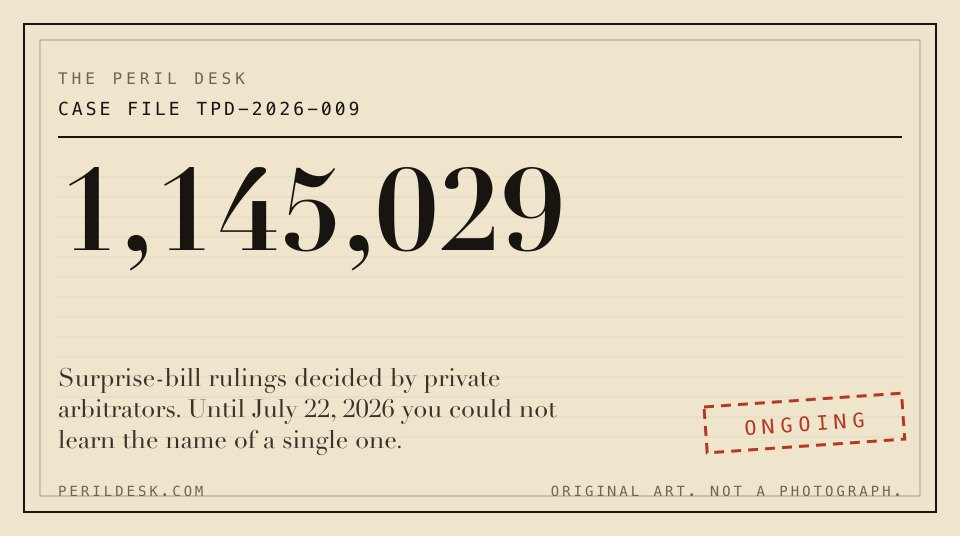
We pulled federal-idr-puf-2025-q3.zip and federal-idr-puf-2025-q4.zip from downloads.cms.gov on August 4, 2026. The Q3 archive is 1,577,396,834 bytes. The Q4 archive is 1,411,010,831 bytes. Between them sit four outcome CSVs holding 3,007,933 dispute line item rows, which resolve to 1,145,029 distinct dispute numbers.
The arithmetic checks against CMS. Summing the payment determination outcome field across those dispute numbers gives 977,661 determinations for the provider side and 165,982 for the plan side. CMS’s own supplemental tables for 2025 Q3 and Q4 report 523,465 plus 454,196 provider wins, and 78,837 plus 87,145 plan wins. Both sums match to the digit. CMS’s headline determination count runs ten higher than the number of distinct disputes actually in the files.
Fifteen firms divide the docket
Federal Hearings and Appeals Services, Inc. decided 271,508 disputes, more than any other entity, ruling for the provider in 82.5 percent of the determinations that named a winner, at a median of 20 business days. C2C Innovative Solutions, Inc. decided 130,872 at 88.9 percent, median 33 days. Provider Resources, Inc. decided 124,095 at 94.5 percent, median 44 days. Island Peer Review Organization decided 104,440 at 97.9 percent.
Then the floor. Medical Evaluators of Texas decided 34,432 disputes and ruled for the provider 54.5 percent of the time. ProPeer Resources, LLC decided 29,146 at 55.7 percent. Livanta, trading as Commence, decided 9,469 at 60.7 percent. Capitol Bridge, LLC decided 10,379 at 66.9 percent. Network Medical Review Company, Ltd. decided 44,445 at 71.2 percent, taking a median of 49 business days.
The rest. MCMC Services, LLC, 84,199 at 91.7 percent. Maximus Federal Services, Inc., 76,794 at 91.5 percent. EdiPhy Advisors, L.L.C., 75,968 at 91.8 percent. iMPROve Health, 72,052 at 87.2 percent. National Medical Reviews, Inc., 43,024 at 72.8 percent. Keystone Peer Review Organization, Inc., 34,206 at 82.2 percent. Across all fifteen, 85.5 percent and a median of 25 business days.
A provider in front of Island Peer Review Organization prevailed 97.9 percent of the time. The same provider in front of Medical Evaluators of Texas prevailed 54.5 percent of the time. CMS describes the selection this way: disputing parties have the option to choose a certified IDR entity from the list of certified organizations. CMS lists 16 certified organizations as of June 30, 2026. Beside one name sits a note. Island Peer Review Organization, not accepting new disputes at this time.
The Departments reset the machinery on August 3
The arbitrators were paid. CMS’s supplemental tables put certified IDR entity compensation at $344,900,924.80 in 2025 Q3 and $304,845,510.80 in 2025 Q4, a total of $649,746,435.60 for six months. Disputing parties also paid $282,966,495 in administrative fees across those two quarters, against reported federal expenditures on the process of $29,459,467.
That gap is closing by rule. The Federal Independent Dispute Resolution Operations final rule, FR document 2026-11140, was published June 4, 2026 at 91 FR 33900. It took effect August 3, 2026. It cuts the administrative fee to $15 per party per dispute for disputes initiated on or after June 11, 2026, down from the $115 in force since January 22, 2024. It requires payers to register in a Federal IDR Registry and carry a registration number onto their disclosures. It requires payers to use specific claim adjustment reason codes and remittance advice remark codes to signal whether a claim is subject to the No Surprises Act. It caps a batched dispute at 50 line items. It gives certified IDR entities 5 business days from final selection to rule on eligibility.
The patient never enters the portal
Read the process the way a person holding a bill would. The plan sends an initial payment or a denial, a 30-business-day open negotiation period runs, and if it fails one of the two companies initiates. CMS states who that can be.
Providers (including air ambulance providers), facilities, and health plans can use the process to determine the payment rates for certain out-of-network charges.
The patient is not on that list, cannot file, cannot submit an offer, and is not told who decided. CMS’s own No Surprise Billing landing page describes the design goal as rights and protections for consumers to end surprise bills and remove consumers from payment disagreements between their providers, health care facilities and health plans.
The scale is one-sided. Of 719,118 disputes initiated in 2025 Q4, 84 were initiated by health plans or issuers. CMS’s table of non-initiating parties for that quarter names who gets pulled in. UnitedHealthcare appears on 171,928 disputes, 24 percent of the quarter’s out-of-network emergency and non-emergency total. BCBS Texas, 129,662. Aetna, 101,613. Claritev, formerly MultiPlan, 72,734. Anthem, 57,646. Cigna, 23,643.
What the determination does is set the out-of-network rate between plan and provider. Both must abide by it and payment is due within 30 calendar days, but the patient’s exposure was already capped at the in-network cost-sharing rate by the statute, and balance billing for covered emergency and in-network-facility services is prohibited. The arbitrator moves money between two companies. The number on the kitchen table was fixed before the portal opened.
The file counts disputes, not people
Say the limits before anyone else does. A row is a dispute line item, not a patient. 357,043 of the 1,145,029 disputes are batched, and a batched dispute can carry many line items belonging to different patients, which is why line item counts and dispute counts diverge sharply by entity. The outcome field records which side prevailed on the majority of line items in a dispute, so a mixed result is compressed into one word. 1,384 disputes closed as split decisions, and 2 more carry no recorded outcome. Capitol Bridge and Livanta appear only in the Q4 file, so their totals cover three months while the others cover six. A win rate says nothing about whether the offer selected was the right one.
The column exists for two quarters. The rule that changes the process underneath it took effect on August 3.