The minute order runs twelve pages. Department 834, Stanley Mosk Courthouse, case number 25STCP01367, filed June 30, 2026. The caption reads Consumer Watchdog, a Non-Profit Organization vs Ricardo Lara, et al. Page eleven carries the sentence that settled who pays for the January 2025 Los Angeles fires.
The petition for a writ of mandate is DENIED. Petitioner’s prayers for declaratory and injunctive relief are DENIED.
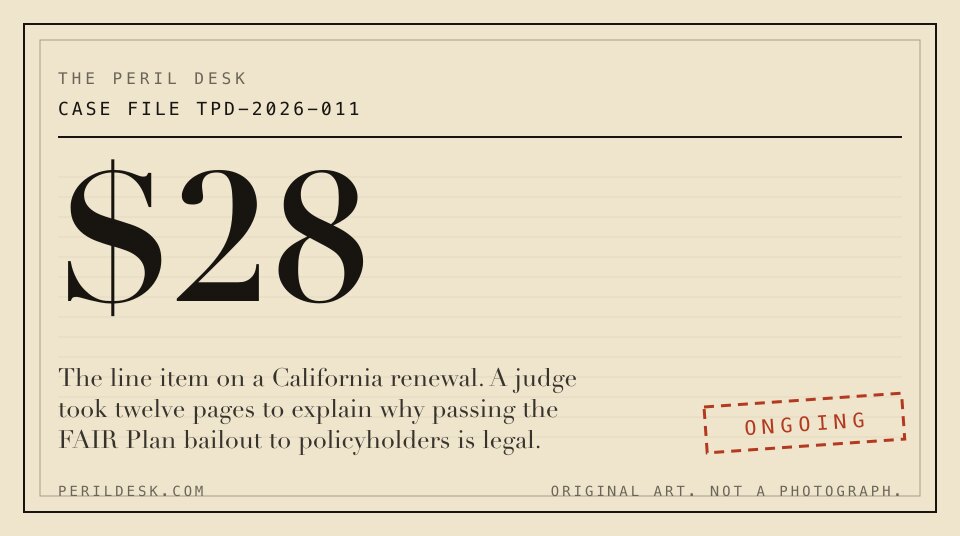
Nothing was refunded. Nothing was paused. The charge at issue is already printed on renewal paperwork across California under a name most people have never read before, and the California Department of Insurance puts the median homeowner’s annual cost of it at $28.
The FAIR Plan Sent Its Members a Bill in February
The California FAIR Plan is not a company anyone chooses. The Court of Appeal called it “an involuntary association of all property insurers within California” in Ohio Casualty Ins. Co. v. Garamendi, and Judge Tiana J. Murillo quoted that line back in her order. Every admitted property insurer in the state is a member. The Assembly Insurance Committee’s oversight background paper of January 28, 2026 records what the association had become by the end of last year. Total exposure of $724 billion, a 230% increase since September 2022. Policies in force of 668,609, up 146% over the same stretch. Almost 6% of California’s property insurance market now sits inside the insurer of last resort.
On February 11, 2025, the FAIR Plan asked to assess its members $1 billion. Commissioner Ricardo Lara approved it that day through Order 2025-1. Bulletin 2025-4, issued the same day, called it the first assessment on its member insurers in over 30 years. Members had 30 days from the date of their notice to remit. The Assembly paper puts the entire prior history at roughly $260 million total between 1993 and 1995, after the Kinneloa and Old Topanga fires and the Northridge earthquake. Bulletin 2025-4 converts that to approximately $563 million in today’s dollars. By January 2026 the committee recorded approximately 5,400 Palisades and Eaton claims and nearly $3.5 billion paid out.
Bulletin 2024-8 Arrived Four Months Before Anyone Needed It
Commissioner Lara issued Bulletin 2024-8 on September 3, 2024. Its subject line describes recoupment procedures “in the Highly Unlikely Event of Assessment by the FAIR Plan,” and its opening notes such an event “has not happened since 1994.” It set three tiers. Where the FAIR Plan assesses up to $1 billion on residential writers, or up to $1 billion on commercial writers, or up to $2 billion combined, member insurers may seek the Commissioner’s prior approval to collect temporary supplemental fees from their own policyholders and recoup up to 50% of what they paid. Above those thresholds they may recoup all of it. High value commercial property policies get a third tier at the full amount.
Bulletin 2025-4, dated February 11, 2025, is the operational version. It confirms Order 2025-1 approved $1 billion, which places the assessment squarely in the 50% tier. Applications had to be filed within six months of the assessment notice, tagged FPA-2025, revenue neutral, with no other rate or rule change bundled in. The Department’s recoupment FAQ requires “confirmation that the temporary supplemental fee is to be collected over 24 months.” Asked whether the recoupment can be extended to a third year, the FAQ answers in one word. No.
The Allocation Runs Backward Two Years
Insurance Code section 10095(c), quoted in relevant part in the order, is where the reach into ordinary households begins. An insurer participates in the association’s writings, expenses, profits and losses “in the proportion that its premiums written during the second preceding calendar year bear to the aggregate premiums written by all insurers in the program.” The Department’s FAQ shows the arithmetic in practice. The 2024 pool year participation rate was based on 2022 written premium. The 2025 pool year was based on 2023 written premium. The split between personal and commercial lines was approximately 97% to 3%. Fire and allied lines were assessed at 100%, commercial multiple peril at 100%, homeowners at 83%, farmowners at 78%.
A company that sold a lot of homeowners policies in 2022 and 2023 therefore owed a large share of $1 billion in 2025. State Farm General’s assessment was over $165 million by its own account. It then asked to recover half from its own book. The approved fee is 1.13% of premium on homeowners and rental dwelling policies at each renewal for two renewal periods, 2.25% for one renewal period on other personal lines, and 0.26% for one renewal period on commercial. Personal lines renewals began carrying it on December 1, 2025. Commercial followed on January 1, 2026.
Judge Murillo Reached Page Ten
Consumer Watchdog filed on April 14, 2025. Two of its three causes of action died at demurrer on July 22, 2025, without leave to amend. What survived was the allegation that pass-through fees disrupt the proportional profit and loss sharing that section 10095(c) requires among members. The court disposed of it on page ten.
The meaning of Section 10095(c) is plain: it governs how writings, profits, losses, and expenses must be allocated between FAIR Plan member insurers. Petitioner objects to the way the Commissioner permits insurers to handle assessments after they are levied. This does not fall within the plain language of section 10095(c).
The court never reached the question of standing. Having found the claim failed on its merits, it did not need to.
The Line Item Sits Below the Premium
Both bulletins impose the same requirement on insurers that win approval. The amount “shall be separately stated on a notice, bill, or policy declaration sent to an insured,” carrying mandated explanatory language that ends with the sentence: “‘Temporary Supplemental Fee’ with an amount will be displayed on a notice, bill, or your policy declarations.” That phrase is the label. The line itself will not say FAIR Plan, wildfire, assessment or bailout. If a renewal declaration shows no such line and no such language, the Department’s Rate Enforcement Bureau published a contact for Bulletin 2024-8 inquiries, and CDI’s consumer hotline is 1-800-927-4357.
Two variables move a household above or below $28. The premium, because the fee is a percentage of premium rather than a flat charge. And the percentage the household’s own carrier was approved to charge, which ranged from 0.26% to 2.25% inside State Farm alone depending on the line. The fee is set at policy issuance. A mid-term endorsement that changes the premium does not change it. It splits equally across installments. It is fully earned if the policy cancels or lapses mid-term.
FAIR Plan policyholders do not pay it. The Department’s FAQ is explicit that the assessment was levied on member insurers and the fee falls on those members’ policyholders. The exception is the difference in conditions wrap policy, which CDI confirms can carry the fee, and whose holders typically also hold a FAIR Plan policy. Everyone else paying the charge is a customer of a private carrier that was conscripted into the association by statute.
Consumer Watchdog counted “over $420 million in consumer pass-through requests” approved as of April 2026. Litigation Director William Pletcher said on July 1, 2026 that the organization disagreed with the decision and was reviewing its options. No notice of appeal appears in the documents reviewed for this piece. The June 30 order denied injunctive relief outright, and the only refund mechanism CDI has published is the one that applies when an insurer over-collects.