Page 16 of the appendix runs nineteen rows deep, one row per company. The column headings are flat. Initial Approvals. Initial Denials. Denial Rate. Appeals Overturned. Appeals Upheld. Overturn Rate. Read across the UnitedHealth Group, Inc. line and the numbers come out 36,124, then 5,362, then 12.9 percent, then 1,022, then 3, then 99.7 percent.
Three. In June 2024, of the 1,025 appealed skilled nursing denials that UnitedHealth Group decided, it upheld three of them.
That table is Appendix B of HHS Office of Inspector General report OEI-09-24-00331, issued June 8, 2026 and posted June 11, 2026. The companion volume, OEI-09-24-00330, carries the same date. Together they cover one month of prior authorization data pulled from the 19 largest Medicare Advantage parent companies by enrollment, which held 29,333,263 enrollees in June 2024, roughly 86 percent of the program.
Nineteen companies logged 109,387 decisions in thirty days
Across the 19 organizations, 95,929 requests for skilled nursing facility admission were approved and 13,458 were denied. That is a 12.3 percent denial rate for a single month, per Appendix B, page 16. The spread between companies is the part that does not average out. Molina Healthcare, Inc. denied 23.4 percent. MHH Healthcare, L.P. denied 0.4 percent, one request out of 242. CVS Health Corporation and Humana Inc. both landed on 13.5 percent. UnitedHealth Group came in at 12.9 percent on the largest volume in the file, 41,486 decisions.
Those three companies took three quarters of all skilled nursing requests and posted three of the five highest denial rates. Nearly 20 million people were enrolled in their plans. Appendix E, page 19, splits the same data by tax status: for-profit contracts denied 12.7 percent of requests, nonprofit contracts denied 8.2 percent.
OIG counted the appeals that never arrived
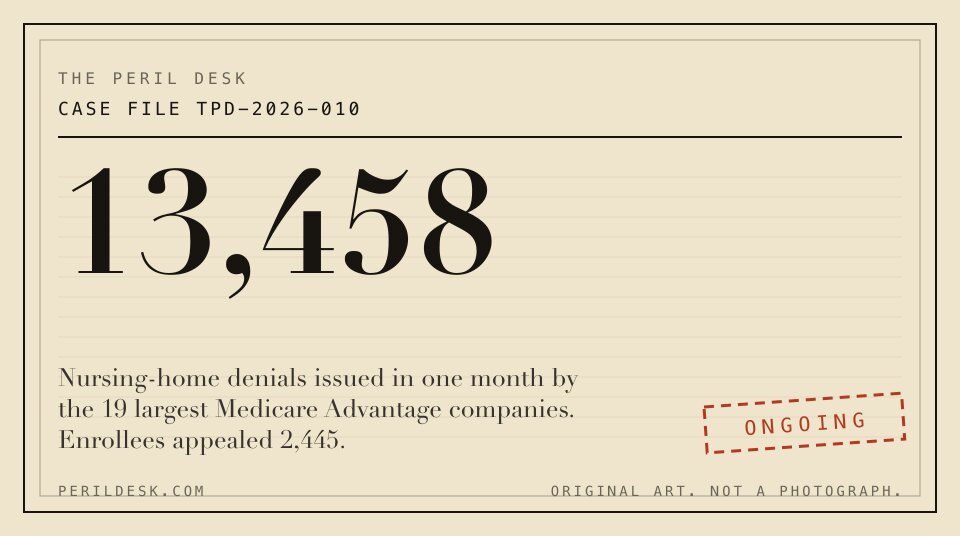
Of the 13,458 denials, 2,445 produced an appeal decision. Plans reversed themselves in 2,313 of those. That is 94.6 percent, which the report rounds to 95. Among companies handling at least 50 appeals, the floor was BCBS of Michigan Mutual Ins. Co. at 90.7 percent and the ceiling was Elevance Health, Inc. at 100 percent, 93 appeals, zero upheld.
The extremely high overturn rate indicates that some enrollees were initially denied medically necessary care and raises concerns about denials that were not appealed.
Denials that were not appealed number 11,013. That is the arithmetic remainder of the file. The report is a data brief built on claims data, and OIG did not review the case files behind any of those 11,013.
The waiting is documented too. The median time from initial request to appeal decision was 6 days, and 17 percent of appeals took 10 days or longer. When a plan approved the request outright, it typically did so the same day, which OIG says enabled a much faster discharge from the hospital. Six days is six days in a hospital bed, waiting.
KFF puts the national appeal rate at 11.5 percent
The OIG file is one month, one service type, and its 18.2 percent appeal rate is unusually high. The national picture is worse. KFF, reading CMS Part C data published January 28, 2026, counted 52.8 million prior authorization determinations by Medicare Advantage insurers in 2024. Insurers denied 4.1 million of them in full or in part, a 7.7 percent denial rate. Enrollees appealed 11.5 percent of those denials. Of the appeals, 80.7 percent came back partially or fully overturned.
Run that out. Roughly 471,500 denials were appealed in 2024 and roughly 380,500 of those appeals succeeded. Roughly 3.6 million denials were never contested by anyone.
Doing the arithmetic the highlights sheet skipped
Here is an estimate, and it is an estimate, not a finding. OIG says plainly that it cannot determine from this data analysis alone whether or how many of these denials were inappropriate.
The formula is simple. Unappealed denials multiplied by an assumed error rate. For the skilled nursing file that is 13,458 minus 2,445, or 11,013, times r.
The floor for r comes from OIG’s own 2022 physician review, OEI-09-18-00260, which found that 13 percent of the Medicare Advantage prior authorization denials it reviewed met Medicare coverage rules outright. At r equals 0.13, about 1,432 of the uncontested skilled nursing denials were wrong. The ceiling is the observed appeal outcome itself. At r equals 0.946, about 10,418 were wrong. The true number sits somewhere in that band. Selection runs through it, because the cases people fight are the cases most worth fighting.
At the floor, that is 1,432 denials in one month that would have met Medicare coverage rules and were never appealed. The estimate is The Peril Desk’s arithmetic, not an OIG finding.
naviHealth denied one request in seven
Appendix C, page 17, breaks the same month out by who actually pressed the button. The contractor naviHealth, which UnitedHealth Group describes as an indirect wholly owned subsidiary, processed 55,176 of the 109,387 skilled nursing decisions, just over half. It denied 14.3 percent. Plans that reviewed requests internally denied 11.0 percent. All other contractors denied 8.9 percent.
Then the plans overturned 96.6 percent of naviHealth’s appealed denials, against 88.6 percent for their own internal denials. Carelon denied 12.8 percent and had every one of its 91 appealed denials overturned, a rate of 100.0 percent.
OIG asked five large plans why nursing home residents fared so badly. Three reported that naviHealth kept supplemental guidance instructing reviewers to consider the reasons an enrollee lives in a nursing facility.
Long-stay residents were denied at nearly four times the rate
Appendix D, page 18: enrollees living in a nursing home for more than 100 days were denied skilled nursing level care 39.5 percent of the time, 1,283 denials against 1,965 approvals. Every other enrollee was denied 11.5 percent of the time. OIG put that gap at nearly four times the rate of nonresidents. Enrollees dually eligible for Medicare and Medicaid were denied 15.7 percent, against 10.5 percent for everyone else.
The companion report is harsher still. OEI-09-24-00330 found that the 19 plans denied 65.3 percent of long-term acute care hospital requests and 54.2 percent of inpatient rehabilitation requests in June 2024. CVS Health denied 79.6 percent of long-term acute care requests, Humana 72.3 percent, UnitedHealth Group 70.9 percent. Those three together denied 72.9 percent, against 42.0 percent across the other sixteen companies, a figure derived from the totals in Appendix B, page 16, of that report. Collectively, plans overturned 36.1 percent of appealed long-term acute care denials and 42.7 percent of appealed inpatient rehabilitation denials. CVS Health overturned 81.6 percent of appealed rehabilitation denials. Humana overturned 14.1 percent.
The regulation gives you sixty days and a treating physician
Under 42 CFR 422.582, a reconsideration must be filed within 60 calendar days after receipt of the written organization determination notice, and receipt is presumed 5 calendar days after the date on the notice. A party to the determination can file. So can a treating physician acting on the enrollee’s behalf, after notifying the enrollee.
Under 42 CFR 422.584, an enrollee or any physician, affiliated with the plan or not, can request an expedited reconsideration. The plan must grant it if the physician indicates that the standard timeframe could seriously jeopardize the life or health of the enrollee or the enrollee’s ability to regain maximum function.
Under 42 CFR 422.590, an expedited reconsideration must be decided within 72 hours. A standard reconsideration for a service runs 30 calendar days, extendable by up to 14. If the plan affirms its denial, it does not get to stop there. It must send a written explanation and the case file to an independent entity, within 24 hours on an expedited request.
A different clock sits beside those. Under 42 CFR 422.62(a)(2)(iii), beginning in 2011, the annual coordinated election period for the following calendar year is October 15 through December 7. It governs coverage rather than appeals. Paragraph (a)(2)(iv) of the same section sets out what an election in that window does: an individual may change from a Medicare Advantage plan to Original Medicare, or to a different Medicare Advantage plan, or from Original Medicare to a Medicare Advantage plan. The 60 days in 42 CFR 422.582 run from the notice, in whatever month the notice arrives.
OIG made three recommendations. CMS did not explicitly concur or nonconcur with any of them.
In cases where denied claims are overturned on appeal, CMS notes the initial denial may still have been warranted if it stemmed from incomplete documentation that was subsequently provided during the appeal.
OIG’s case file review of post-acute care denials, OEI-09-24-00332, is expected in fiscal year 2027.