On the night of January 11, 2009, an air traffic controller heard a pilot over Alabama report that his windshield had imploded and that he was bleeding heavily.
The aircraft was a single engine Piper Meridian, registration N428DC, about 35 miles southwest of Birmingham on a filed flight from Anderson, Indiana, to Destin, Florida.
Then the radio went quiet, and the plane kept flying.
It stayed in the air, on autopilot, with nobody inside it.
The gap between the call and the crash
A mayday, which is the aviation distress call, is supposed to be followed by a descent, a landing or a wreck.
None of those followed. The plane held its heading toward the Gulf coast while the man who had called it in was already under a parachute canopy over central Alabama.
The National Transportation Safety Board record has the sequence in the pilot’s own transmissions. He reported turbulence, then a cracking windshield, then the loss of the door, then locked flight controls, then that he was “graying out.” He said he intended to “point the aircraft at the gulf.” Then he parachuted from the airplane without telling the controllers he was leaving.
The plane ran until it came down under power in wooded terrain near Milton, in the Florida panhandle, about 100 yards from a residential area, at about 9:20 that night.
Nobody on the ground was hurt. That part was luck.
The pilot was Marcus Schrenker, an Indiana money manager.
What he was flying away from
Schrenker was not having a normal week.
Contemporaneous reporting at the time of the crash placed him under an Indiana state securities probe, and CBS News reported a $533,500 federal judgment entered against his firm, Heritage Wealth Management Inc.
The flight was logged as a routine trip. It was not one.
The guilty pleas that followed settled part of that and not all of it. In federal court Schrenker admitted wrecking the aircraft and sending the Coast Guard out after him. In Hamilton Superior Court in Indiana he pleaded guilty to five counts of securities fraud. Neither plea adjudicated the wider state probe reported that week, and a civil money judgment against a firm is not a criminal finding against the man who ran it.
The parts that were prepared in advance
A staged crash needs a way to leave the crash.
The NTSB found that Schrenker had parachuted “near where he had previously stashed a motorcycle.” The Associated Press, in a report carried by Fox News, said police believed it was a red motorcycle with full saddlebags, in a storage unit in Harpersville, Alabama, rented the day before the flight.
That single detail is what converts the night from a panic into a plan. Parachutes can be an emergency. A motorcycle rented into storage the day before cannot.
Before he reached it, a man carrying Schrenker’s license, in CBS News’ wording, walked into Childersburg, Alabama, wet from the knees down and wearing what looked like flying goggles, and said he had been in a canoe accident. CBS has him saying it to police; the Wikipedia reference article has him turning up at a residence. Then he rode south.
A tent near Quincy, Florida
On the evening of Tuesday, January 13, 2009, United States Marshals and Gadsden County deputies surrounded a campsite near Quincy, Florida.
They found Schrenker inside a tent, semi conscious, with a wound to his left wrist that the marshals called very serious, in what the wire coverage described as an apparent suicide attempt.
Frank Chiumento, an assistant chief with the Marshals in Florida, said afterward: “He muttered ‘die’ at one time as if he didn’t want the first aid that we were rendering to him.”
He was taken to a hospital, treated, and taken into custody.
Two days. That is the entire operational life of the plan, measured from the false distress call to the arrest.
The two courts
The case split cleanly into a federal half and a state half, and both halves ended in guilty pleas.
In federal court in Pensacola, in the Northern District of Florida, Schrenker pleaded guilty to willfully wrecking an aircraft and to causing the Coast Guard to attempt to save his life and property when no help was needed.
On August 19, 2009, he was sentenced to 51 months in prison, a little over four years, followed by three years of supervised release.
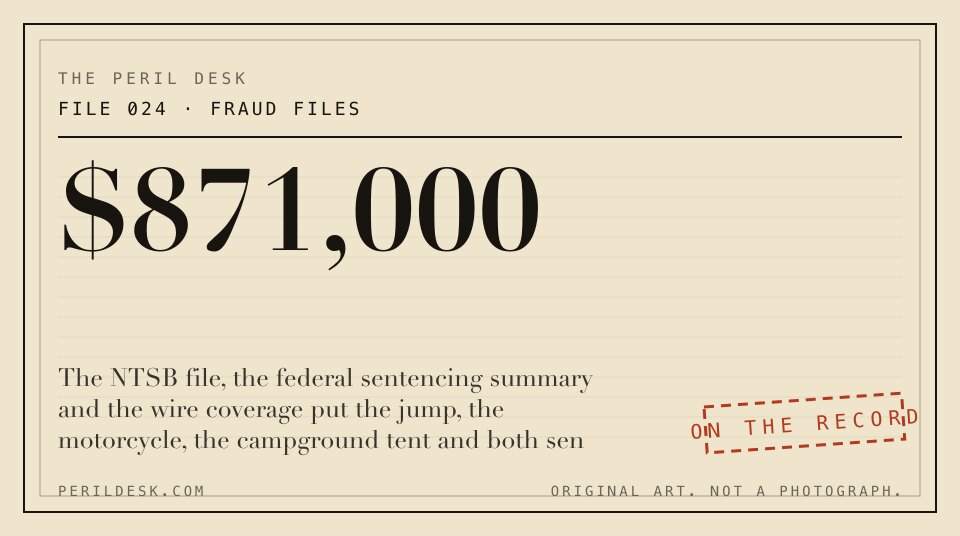
The sentence also priced the night. He was ordered to pay $34,649.07 in restitution to the United States Coast Guard, and $871,387.85 to Harley Davidson Credit Corporation.
In Indiana, the securities case went its own way. In October 2010 he was sentenced to 10 years, ordered to run consecutively, meaning after the federal term rather than alongside it.
The stunt and the fraud were punished separately because they were separate crimes.
What the ledger looked like afterward
There is a version of this story where a staged death pays somebody.
That is not this story. Schrenker was alive and in custody within two days of the crash, and the file contains no completed death benefit of any kind.
What the night did produce was real cost with no offsetting anything.
A destroyed turboprop aircraft. A Coast Guard search launched on a false report, billed at $34,649.07. A crash site in the woods 100 yards from occupied homes. A federal aviation investigation. Two prosecutions.
Every item on that list was paid for by somebody other than the man who caused it, until the restitution order sent part of the bill back.
What a false mayday summons
Fraud on paper is built to stay quiet. A form, a signature, a number moved from one column to another, none of it meant to draw a second look.
The staged crash is the opposite species. It is loud by design, and loudness is what killed it.
A false mayday summons the exact institutions least likely to lose interest. Air traffic control logs the call. The National Transportation Safety Board opens a file on the wreck. The Coast Guard treats a false distress report as a federal offense in its own right.
By the time anyone asked whether the pilot’s story held together, several agencies already had records of the same night. The NTSB examination found the door still attached to the airframe and the windshield undamaged and secured in its frame.
The plan required a disappearance. What it actually generated was documentation.
The flight after the jump
The number that keeps the case in circulation is the distance the plane covered after he left it.
The Wikipedia reference article puts that autopilot flight at 200 miles. The Associated Press, in the report carried by Fox News, put the crash site over 200 miles south of where authorities believe he parachuted. Both figures measure the same leg, from the jump to the wreck. The NTSB narrative prints no track distance at all; it gives only the crash position, in wooded terrain about 18 nautical miles north of the Gulf.
About 200 miles of controlled level flight, executed perfectly, by an empty cockpit. The NTSB’s one line probable cause reads: “The pilot’s intentional inflight abandonment of the airplane.”
The aircraft was the only participant in the evening that behaved exactly as designed.