Challenger lifted off at 8:00 a.m. EST on February 3, 1984. Eight hours into the flight the crew opened the sunshield in the payload bay and spun Westar VI out into the dark, a Hughes-built cylinder that Western Union had bought to carry telephone traffic across the United States. Forty-five minutes later the satellite’s McDonnell Douglas upper stage lit and quit. The exit cone of its Star 48 motor came apart about four seconds after ignition. Westar VI settled into an elliptical orbit topping out at 655 nautical miles, a fine address for a satellite nobody needs to work.
Three days later the same crew deployed Palapa B2 for Indonesia and turned the orbiter so the cameras could watch the burn. It looked normal. It was not. Engineers worked out afterward that the second motor had failed the same way as the first. Two identical Hughes 376 satellites, two identical failures.
The intended address was 22,300 miles up, in the belt where a satellite hangs over one spot on the equator and stays useful for a decade. NASA’s history of the flight records where the pair ended up instead. Orbits roughly 160 by 600 miles high, too low to carry a nation’s telephone traffic and too high to come down on their own.
The bill arrived in London.
The day they stopped being Indonesia’s.
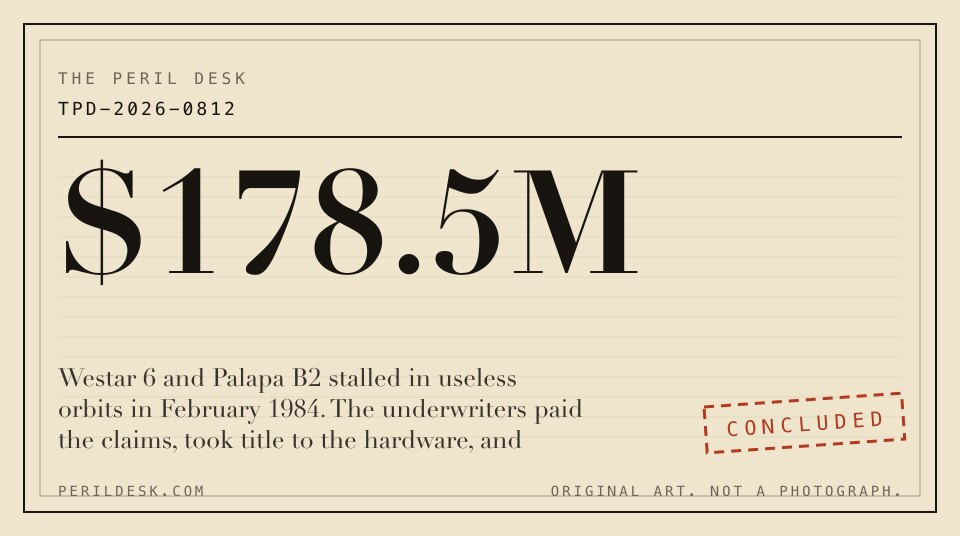
Western Union collected $105,000,000 on Westar VI. Perumtel, the state telecommunications agency of Indonesia, collected $73.5 million on Palapa B2. Lloyd’s puts the combined insured value of the two at $180 million. Both were settled as total losses, and a total loss carries one line that most people meet exactly once in a lifetime, on the morning a tow truck takes their car away for good. Lloyd’s states it in a single sentence on its own website. “Having paid the claim, ownership of the satellites had been acquired by underwriters.”
Read that again with a Honda in mind. The consumer version runs on the same two moves. Your insurer decides the car is a total loss and writes you a check for its actual cash value. Then it takes the title, and the car goes to auction with a salvage brand on its paperwork. If the auction beats the estimate, the difference belongs to the insurer. Nobody sends you a second check.
Lloyd’s ran that exact play in February 1984. The only unusual variable was the mileage. Two communications satellites, in orbit, moving at orbital speed, became the property of an insurance market on Lime Street in London, which now owned hardware it had no way to reach.
The repo bill came to $10.5 million.
On September 7, 1984, Hughes and the majority insurers of Westar VI reached an agreement to retrieve the satellite. That date survives inside a California appellate opinion filed five years later, which is how a great deal of insurance history survives. Lloyd’s then paid NASA and Hughes Aircraft $10.5 million to fly the recovery and inspect the hardware once it was back on the ground.
Set that against $178.5 million already gone. It is the arithmetic every tow yard in America runs. Spend a little, recover the wreck, sell the wreck.
One man held it for ninety minutes.
Discovery launched on November 8, 1984, with Frederick Hauck commanding, David Walker in the right seat, and Joseph Allen, Anna Fisher and Dale Gardner as mission specialists. Stowed in the payload bay was a spike that engineers had named the Apogee Kick Motor Capture Device. Everyone called it the stinger. The plan was to fly a man in a jetpack up to a spinning satellite, drive the spike into the throat of its dead motor, and hold on.
On November 12, Allen flew the stinger into Palapa B2 and stopped its spin. Then the plan came apart. The A-frame adapter that was supposed to clamp the satellite to the shuttle’s robot arm would not seat. “A rigid structure, part of the satellite’s wave guide equipment, was protruding further outboard than had been expected,” Allen said, “and the A-frame would not fit.”
Walker offered the alternative from inside the cabin. Allen would hold the satellite by hand. NASA’s own caption on photograph 51A-41-058 records what that looked like. “Astronaut Joseph P. Allen IV appears to be lifting weights. Astronaut Dale A. Gardner holding on. Actually, Dr. Allen is the sole anchor for the top portion (and most of) the captured Palapa B-2 communications satellite.” Allen stood there for 90 minutes, a full lap of the planet, while Gardner worked nine bolts by hand. The spacewalk ran six hours.
Two days later they did it again to Westar 6, Gardner on the stinger and Allen serving as a human A-frame. That one took five hours and 42 minutes. With both satellites strapped down in the bay, Gardner held a hand-lettered sign up to the cameras. It said FOR SALE.
In London, Lloyd’s rang the Lutine Bell at its Lime Street headquarters.
Reagan handed out salvage medals in December.
On December 7, 1984, all five astronauts stood in the Oval Office while President Reagan pinned Lloyd’s silver medals on them. Lloyd’s chairman Peter Miller was there. So was Stephen Merrett, the leading underwriter on the risk. The White House barred reporters from the room. The medal dates to 1893 and honors those who “by extraordinary exertions have contributed to the preservation of property from perils of all kind.” Lloyd’s had given it to salvage crews five times since the Second World War, and never once for a job that did not happen at sea.
UPI filed the market’s view of the ceremony the same day. “The insurance syndicate now can sell the satellites on the open market, with guesses of their value ranging from $30 million to $40 million apiece.”
The underwriters sued the rocket maker.
In 1986, five of the Westar insurers went after the companies that built the failed rocket. Appalachian Insurance Company, Commonwealth Insurance Company, Industrial Indemnity, Mutual Marine Office, Inc. and Northbrook Excess & Surplus Insurance Company sued McDonnell Douglas, Morton Thiokol and Hitco in subrogation, on negligence and strict liability, standing in the shoes of the customer they had already paid.
The opinion is worth reading for the anatomy alone. McDonnell Douglas supplied the payload assist module, which the court breaks into airborne support equipment, “consisting principally of a spin table, cradle, sun shield and related control electronics,” and a Star 48 motor built by Morton Thiokol. The nozzle that disintegrated was made by Hitco, under a subcontract with Thiokol. One exit cone, three companies, and in the end nobody the insurers could collect from.
Article 14 of the NASA launch services agreement bound the parties “not to bring a claim against or sue the other party, NASA, or other NASA customers,” and it pushed that protection down to “contractors and subcontractors at every tier, as third party beneficiaries.” On August 29, 1989, the California Court of Appeal affirmed summary judgment against the insurers. The waivers were unambiguous and they were enforceable.
So the $105 million stayed spent. The hardware in the shuttle bay was the only recovery anyone was ever going to get, which made the resale the entire point of the exercise.
Both of them flew again in one week.
Sattel Technologies Inc. bought Palapa B2 from the underwriters, then contracted with the government of Indonesia to refurbish and relaunch it. Hughes did the work. “The spacecraft was in super shape,” Hughes vice president David Braverman said. “The nine months of orbital exposure it had were very benign and basically we only had to replace the items we used extensively during the nine months, the batteries, the on-board ... propulsion system.” Renamed Palapa B-2R, the rebuilt satellite was valued at roughly $60 million. It went up on a $50 million Delta 2 from Cape Canaveral at 6:28 p.m. EDT on April 13, 1990, under a $27.5 million insurance premium, a $137.5 million project flying on a Friday the 13th.
Westar 6 went to a Hong Kong consortium of Cable and Wireless, Hutchison Whampoa and China International Trust and Investment Corp., which renamed it AsiaSat 1 and, by UPI’s reporting at the time, paid nearly $50 million for it. Six days before the Palapa launch, at 9:30 p.m. on April 7, 1990, a Long March 3 stood on the pad at Xichang in Sichuan Province with the American satellite on top. “Fire,” the mission commander ordered. It was China’s first commercial launch, and the first satellite ever put back into space after being pulled out of it.
AsiaSat 1 checked out and went to work about six weeks later, parked 22,300 miles above the equator near Singapore, carrying television into thirty Asian countries for a consortium that had bought it secondhand from the people who paid Western Union to take it away.