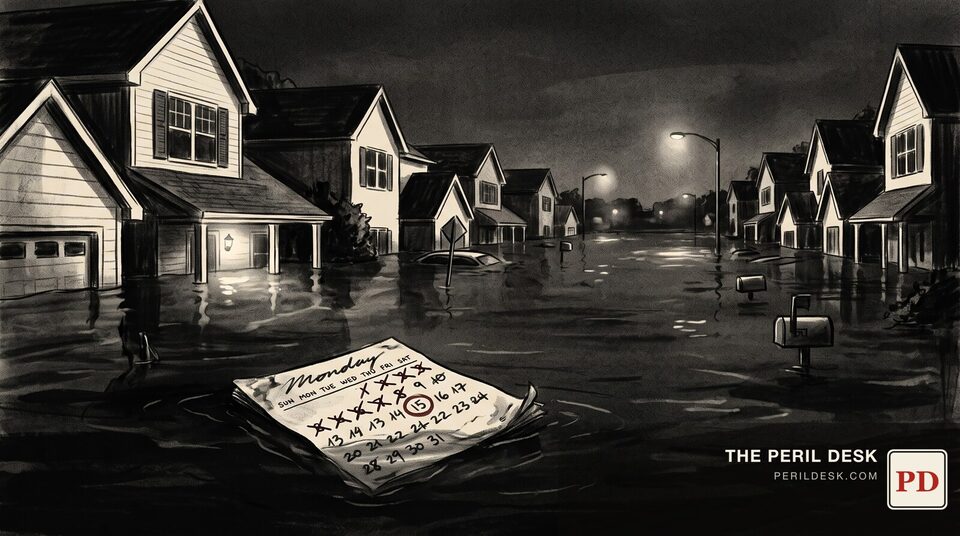
After Hurricane Harvey, the National Flood Insurance Program paid its policyholders an average of $118,000 per claim. Households without a policy received FEMA disaster grants averaging $4,400. That is a 27-fold difference between two neighbors on the same flooded street, and by FEMA’s own count, 80 percent of the households Harvey hit stood on the wrong side of it.
Harvey came ashore near Rockport, Texas on the night of August 25, 2017, a Category 4 storm that stalled over the coast and wrung nearly 50 inches of rain out of the sky above parts of Houston. It killed nearly 70 people, damaged more than 300,000 structures, and left a bill of $125 billion. In Harris County alone, County Judge Ed Emmett said more than 100,000 flooded homes carried no flood insurance.
Houston did not get unlucky on paperwork. The region went into the storm holding fewer flood policies than it had five years earlier, and a federal clock guaranteed that nobody could fix that once the forecast turned.
The Cutoff Passed on July 26.
Federal regulation 44 CFR 61.11 sets the rule. A new NFIP policy takes effect at 12:01 a.m. on the 30th calendar day after the application date and premium payment. The regulation lists three exceptions. Coverage bought in connection with making, increasing, extending, or renewing a mortgage starts at loan closing. Coverage bought within 13 months of a revised flood map starts the next day. Coverage bought within 60 days of a wildfire’s containment, where flooding on federal land follows the burn, starts the next day.
None of the three involves weather. There is no exception for a hurricane in the Gulf.
Run the dates. For a policy to be active when Harvey made landfall on August 25, the application had to be in by July 26, four weeks before the storm formed into anything worth naming. A policy bought on August 1 went live on August 31. By August 30, Harvey had already moved on into Louisiana. The rain outran the paperwork by a full day, and for most of Houston the water had been standing in living rooms since the 27th.
The clock binds renters the same way. The NFIP sells contents-only coverage, up to $100,000 for belongings, and standard renters policies exclude flood damage entirely. Private carriers write flood coverage outside the NFIP and set their own effective-date rules, but the federal program, which holds most of the market, waits its full 30 days.
What Houston Dropped Before the Rain.
The Associated Press analyzed FEMA policy data after the storm and found the region had been shedding coverage for years. Harris County held nearly 275,000 flood policies at the end of 2012 and about 250,000 in June 2017, a loss of 25,000 insured properties. The city of Houston fell from 133,000 policies to 119,000. Pasadena dropped nearly 20 percent. Baytown dropped 22 percent.
“When you start to see policies drop like this, FEMA should have done something about this,” said Robert Hunter, who ran the federal flood insurance program in the 1970s. His estimate at the time: fewer than two in ten homeowners with flood damage would turn out to have flood insurance.
He was close. FEMA’s figure came in at 80 percent uninsured among affected households. The Institute for Regional Forecasting at the University of Houston put the share of Houstonians without flood coverage at 83 percent.
The Maps Gave False Comfort.
The uninsured were not only the people outside the lines on FEMA’s flood maps. An AP analysis found that fewer than one in five properties inside high-risk flood zones, the areas where lenders require coverage, actually had it. Outside those zones, coverage was close to nonexistent, and Harvey did not read the maps. FEMA counted more than 161,000 damaged homes in the Houston metropolitan area, and 24 percent of them were uninhabitable for at least 30 days.
This is the standing pattern, not a Harvey quirk. FEMA’s own FloodSmart data shows that from 2014 to 2024, almost one-third of NFIP flood claims came from outside high-risk flood areas.
For the minority who held policies, the program performed. The NFIP paid $8.9 billion across 76,257 Harvey flood claims. The money arrived as a contractual payout, not a loan and not a grant application.
The Buyers Arrived in September.
The surge in flood insurance purchases came after the water went down. From July 2017 to May 2018, flood policies in Texas grew more than 18 percent. Harris County jumped nearly 23 percent. Fort Bend County, where the Brazos left its banks, grew 54 percent. Houston passed Miami to become the American city with the most flood insurance policies.
Every one of those new policies sat through its own 30-day wait during a season with no storm on the map, which is the only time the wait costs nothing.
Howard Kunreuther, who studies disaster insurance at the University of Pennsylvania, told the AP what tends to happen next: people buy for a few years after a big disaster, then cancel, because a policy that never pays starts to feel like a bill for nothing. The bill is not large by the standards of the payout. The average NFIP policy now runs $956 a year, and the average NFIP claim payment is $68,000.
Harris County’s own recent history says the canceling has happened before. The county held nearly 275,000 flood policies at the end of 2012. In June 2017, weeks before landfall, it held about 250,000.