A suspect the size of a piano.
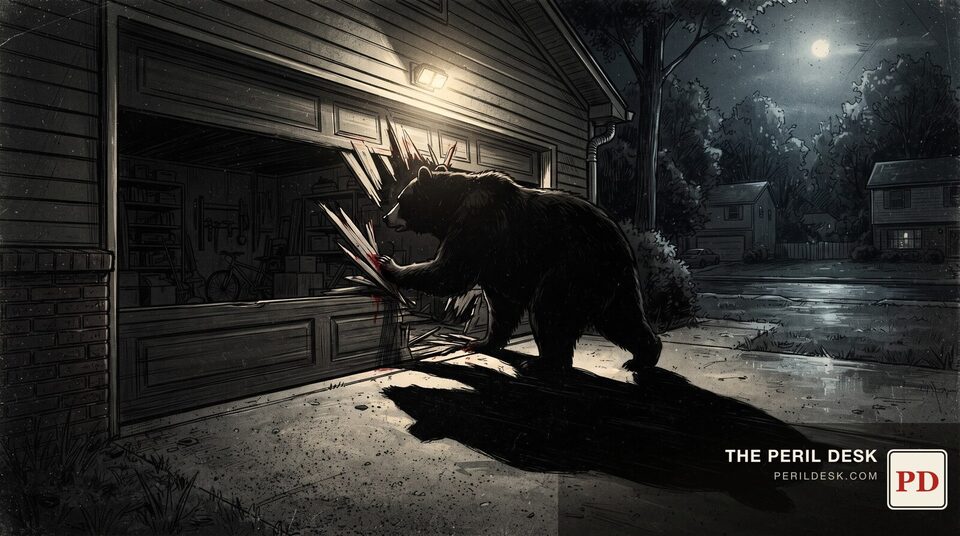
By February 2022, South Lake Tahoe, California, had pinned 28 home break-ins on a single black bear. Officials put his weight at as much as 500 pounds, roughly double a large male black bear. Residents of the Tahoe Keys, a grid of canal-front vacation homes on the lake’s south shore, called him Hank the Tank, and wildlife agencies had logged more than 150 reports about him. His method was not subtle. He burst through garage doors and front doors, sometimes while the owners were home. On February 18, 2022, he went through a house on Catalina Drive, the latest address on the list.
“This is a severely food habituated bear,” said Peter Tira, a spokesperson for the California Department of Fish and Wildlife, that month. “What that means is this bear has lost all fear of people and it sees people and homes as a source of food.” The department had been tracking the animal for more than six months. Relocation was considered pointless; Tira told reporters that a bear this habituated starves in the wild. The usual ending for a conflict bear of that grade in California is euthanasia, and a community meeting about the bear was already on the calendar in the Keys.
Then the case fell apart. Hank the Tank, as charged, did not exist. On February 24, 2022, CDFW announced that DNA collected from the break-in scenes belonged to at least three different bears. The 500-pound male serial burglar was a composite: several animals, similar habits, one nickname. The department scrapped the manhunt and replaced it with a lab project, saying it would trap bears in the area, tag them, and collect DNA. “CDFW is not going to euthanize any bears that are trapped during this effort,” the agency said.
What the hair evidence started.
The tagging program ran for more than a year with less press than a single broken door had drawn in 2022. In March 2023, biologists found a large female denning near South Lake Tahoe with three cubs. They immobilized her, fixed an ear tag reading 64F, fitted a satellite tracking collar, and implanted PIT tags, the same microchips used for house cats, under the cubs’ skin. She shed the collar in May. The genetic file kept growing anyway. When the matching settled, 64F was linked by DNA to at least 21 break-ins between February 2022 and May 2023, plus other suspected entries and property damage. The public had spent that entire stretch calling her Hank.
The last house call.
On August 4, 2023, CDFW biologists immobilized 64F at a South Lake Tahoe home, with all three cubs captured in the same operation. One cub had been hit by a car a month earlier and was still getting around on the injury. The department announced the capture the same day and, citing broad public interest in the animal, arranged a different ending than the one conflict bears usually get. The cubs went to Sonoma County Wildlife Rescue in Petaluma to unlearn everything their mother had taught them about doors. 64F rode a transport to The Wild Animal Sanctuary near Springfield, Colorado, which CDFW said had agreed to provide long-term care, and arrived the morning of August 7. Colorado Gov. Jared Polis posted a welcome for “Henrietta the Tank.” The name stuck. In June 2024, after ten months of rehab, her three sons were released into the eastern Sierra Nevada, microchips and all.
The other paperwork.
Every splintered door frame in the Tahoe Keys was also an insurance file. Standard homeowners policies exclude damage from rodents, vermin, birds, and insects, which is the slow damage of nesting and infestation. A bear is none of those things. A bear removing a garage door in one motion is sudden, accidental damage from a wild animal, and that is the covered side of the line. On the standard HO-3 form, the dwelling is covered on an open-perils basis, meaning anything not specifically excluded is in, and bears are not specifically excluded.
State Farm’s published guidance reads: “A standard homeowner’s policy generally covers bear damage such as torn siding, shattered windows, and doors, plus harm to interior items such as furniture.” Farmers takes the same position on large animals that cause sudden, unexpected damage. The deductible comes off the top. Dwelling coverage picks up the structure, personal property coverage picks up the wrecked couch and the emptied kitchen, and a renters policy runs the same contents logic inside a landlord’s building, per the peril list on the form.
Cars are their own line item. Bear damage to a vehicle falls under comprehensive coverage, the bucket that holds hail, theft, and deer, not collision, and it carries no fault. State Farm counted 2,350 bear collision claims across 2020 and 2021 and estimated 13,687 industry-wide, with California ranked first among states. The Tahoe Basin adds its own genre: in Tahoe Vista, one bear shut itself inside a parked car and took the interior apart.
230 acres, no doors.
Henrietta lives in a 230-acre natural habitat at the sanctuary’s roughly 10,000-acre refuge outside Springfield. She was never the whole story in the Keys; the DNA of at least two other break-in bears sits in CDFW’s records, unattached to any nickname. Her sons are somewhere in the eastern Sierra, carrying their microchips. Her habitat covers 230 acres of open country. It does not have doors.