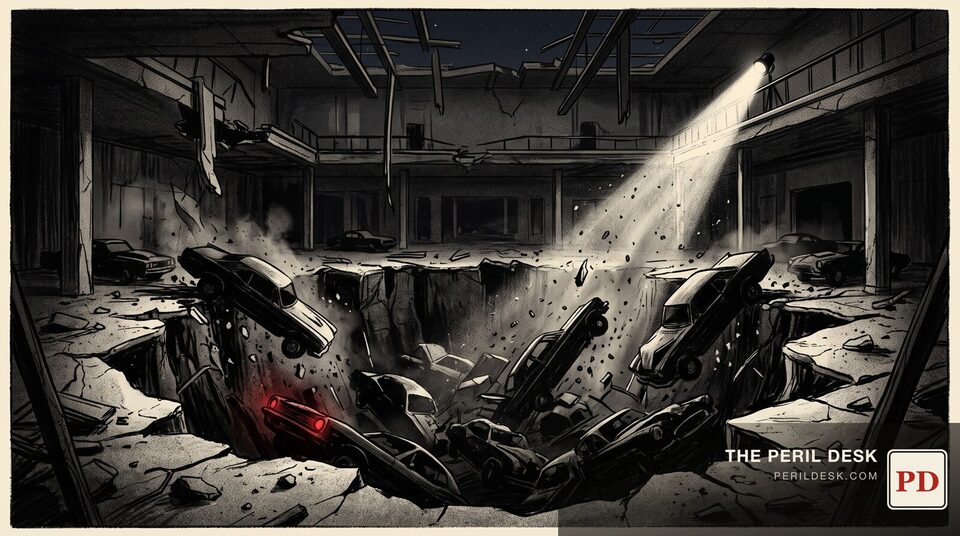
The National Corvette Museum sits in Bowling Green, Kentucky, a few miles from the plant that has built every Corvette since 1981. At 5:38 a.m. on February 12, 2014, the museum’s security system started registering motion inside the Skydome, the 140-foot circular hall where the rarest cars in the collection were parked under a yellow spire. There were no intruders. The floor was leaving. A sinkhole roughly 40 feet wide, 60 feet long, and 30 feet deep had opened beneath the display ring, and eight Corvettes went down with the concrete. By December 31, 251,258 people had paid to see the aftermath, the highest attendance in the museum’s history.
Nobody was inside. The cars fell in the dark, recorded by ceiling cameras installed to catch thieves. Within about eighteen months the museum’s own upload of the collapse had been watched roughly 8.5 million times on YouTube. It was the most profitable disaster the museum ever had.
The list nobody wanted to read out loud.
South-central Kentucky is karst country. Rainwater eats the limestone from below, which is why Mammoth Cave, the longest known cave system on Earth, is up the road. The cave under the Skydome had simply never introduced itself before its roof let go.
The casualties, oldest first: a 1962 Corvette in Tuxedo Black. The 1984 PPG pace car, a one-off built with a custom body and turbine wheels. The 1 millionth Corvette, a white 1992 convertible driven off the Bowling Green line as a milestone. A 1993 ZR-1 Spyder show car. A ruby red 1993 40th Anniversary coupe. A 2001 Z06 tuned by Mallett and nicknamed the Hammer, donated by a Florida couple. The 1.5 millionth Corvette, a white 2009. And the 2009 ZR1 prototype known as the Blue Devil, the test mule for the most powerful Corvette GM had built to that point.
“Six of those vehicles was owned by the museum and two of them were owned by General Motors,” executive director Wendell Strode said in a radio interview that morning. The ZR-1 Spyder and the Blue Devil were GM’s, on loan from its Heritage Collection. The other six were the museum’s problem, and its insurer’s.
What came out of the ground first.
Recovery took until April. The Blue Devil, first out, fell about 30 feet, landed mostly upright, started on the first try, and drove out of the Skydome under its own power. The 1962 and the 1 millionth came up battered but recognizable. The cars that had gone in early and been buried under 4,000 tons of collapsing floor and dirt came up looking like crushed cans. The Mallett Hammer, the last one pulled out, was located by digging for it. Hagerty put the combined value of the eight cars at more than $1 million; the two milestone cars were effectively priceless, because there is no market price for the 1 millionth of anything.
The museum’s property policy turned out to include sinkhole coverage through Chubb, a fact the staff did not realize until the ground made it relevant. The building claim eventually covered repairs that ran to about $5 million, everything except the museum’s deductible, which donations paid. GM’s first announcement promised restoration of all eight cars. Ten months of estimates later, the plan had shrunk to three, because rebuilding the worst five would have meant replacing so much that nothing original remained. Chevrolet restored the Blue Devil in six weeks and unveiled it at SEMA in November 2014. The other five stayed exactly as the hole left them, which turned out to be the smartest display decision in the building.
The car that was signed from the inside.
The 1 millionth Corvette went to GM’s Design Center in Warren, Michigan, where about 30 craftspeople spent more than four months and 1,200 hours on it. When they took the car apart, they found that workers at the Bowling Green plant had signed the parts as it went down the line in 1992. Hidden autographs, all over the car. The team saved every signature except one. A panel signed by assembly worker Angela Lamb was too damaged to salvage or scan, so in September 2015 GM brought Lamb to the museum and she signed the replacement part by hand, 23 years after the first time. The museum restored the third car, the 1962, in its own shop with Chevrolet’s money, and revealed it on February 12, 2018, four years to the day after the collapse.
The hole becomes the headliner.
Then the numbers started coming in. Attendance in 2013 was 150,462. In 2014 it was 251,258, a 67 percent jump and an all-time record. The gift shop sold jars of sinkhole dirt for $10 and moved nearly 2,400 of them. The museum’s Facebook following quadrupled. “People just really enjoy hearing the story and like seeing the damage,” museum spokeswoman Katie Frassinelli said.
So in June 2014 the board voted, in a sentence with no precedent in museum governance, to keep a portion of the sinkhole open permanently and display cars in it. The estimate for preserving part of the hole started around $500,000 above the cost of a normal repair. Then the engineers added safety features and humidity barriers, and the premium grew to about $1 million. In August the board reversed itself and voted to fill the whole thing. “We really wanted to preserve a portion of the hole so that guests for years to come could see a little bit of what it was like, but after receiving more detailed pricing, the cost outweighs the benefit,” Strode said.
Crews packed the cavity with about 4,000 tons of crushed stone, anchored the new floor to bedrock with steel micropiles, and reopened the Skydome in the summer of 2015. In 2016 the museum opened a permanent exhibit called Corvette Cave In, with the eight cars arranged close to their original parking spots and the sinkhole’s outline marked on the new floor. One feature was kept from the original hole. Through a viewing port, visitors can look more than 30 feet straight down into the cave that ate the cars.