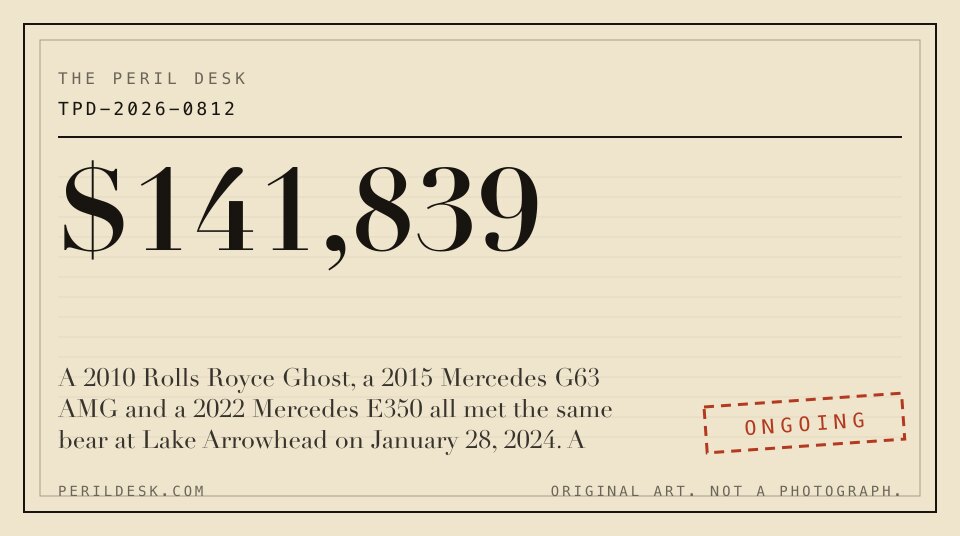
On January 28, 2024, a bear got into a 2010 Rolls Royce Ghost at Lake Arrowhead and wrecked the interior. The claim reached the car’s insurer with video attached. Two more claims followed at two other companies, same date, same place, one for a 2015 Mercedes G63 AMG and one for a 2022 Mercedes E350, each with its own footage of the animal inside the car. The three claims cost the three insurers $141,839.
The bear was a person in a costume.
That is the finding of the California Department of Insurance, and three of the people who filed no longer contest it. Alfiya Zuckerman, 39, of Valley Village, and Ruben Tamrazian, 26, of Glendale, each pleaded no contest to felony insurance fraud for injuring or destroying insured property. Vahe Muradkhanyan, 32, of Glendale, pleaded no contest to felony insurance fraud for presenting a false insurance claim. The Department announced all three sentences on April 16, 2026. Its detectives had already given the case a name, Operation Bear Claw.
The county where the lie was plausible
Lake Arrowhead sits in the San Bernardino Mountains, and that is bear country. The black bear is the only bear species living in California today, the grizzly having been wiped out with the last documented sighting in 1924. The state’s own wildlife agency tells mountain residents to pull unsecured food, trash and strongly scented items out of their vehicles, sunscreen included. A bear in a parked car up there is an ordinary thing to report.
Black bears are omnivores that, in that agency’s words, “will consume nearly anything, including seeds, plants, berries, other animals, pet food, human food, and trash.” The standing warning about them in California is property damage, not attack. Encounters that injure a person are rare. Bears break things.
A wrecked car interior is also an ordinary thing to be paid for. The Insurance Information Institute lists contact with animals inside comprehensive coverage, the optional half of an auto policy that answers for damage other than collisions. Fire, theft, hail, falling branches, broken windshields, animals. Collision, the other half, answers for hitting an object or flipping the car. A bear is not an object you hit.
So the story held up. The arithmetic did not. Three claims. Three different insurance companies. One date. One location.
One of those companies flagged it, and that step is not a courtesy. California Insurance Code section 1872.4 gives an insurer that reasonably suspects an act of insurance fraud 60 days from that determination to send notice to the Department’s Fraud Division. Roughly 1,100 insurers file an annual report on their anti-fraud operations with the Department every year, and the regulations require each of them to run a Special Investigative Unit whose job is to find claims like these and hand them over.
The duty has two written exceptions. An insurer can skip the notice if further investigation showed the original suspicion was unfounded, or if the insurer and the claimant reached a settlement and the insurer has no reasonable grounds to believe fraud occurred. Neither applied. The investigation began, the Department wrote, after an insurance company suspected fraud.
The form goes onto a very large pile. In fiscal year 2023-24 the Fraud Division took in 12,559 suspected fraudulent claims on the automobile side alone, opened 602 new cases, made 272 arrests and referred 354 cases to prosecuting authorities. The potential loss across all of it came to $207,629,944. The bear was one line in that.
The Department does not prosecute. It refers. In that same fiscal year 34 California counties split $16,265,714 in state grants for automobile fraud prosecution, and district attorneys around the state prosecuted 1,036 cases involving 1,111 defendants, won 343 convictions and had $1,772,027 in restitution ordered by the courts. The Legislature’s own finding, written into the program that pays for the work, is that organized automobile fraud “endangers the safety of the public and drives higher insurance premiums in certain urban and low-income areas of the state.”
The Department called a biologist
Detectives pulled the footage and watched it. They decided the bear was a person in a costume. Then they did something that shows up in almost no fraud file. They sent all three videos to the California Department of Fish and Wildlife and asked a biologist to review them.
The biologist “also opined it was clearly a human in a bear suit,” the Department wrote.
Detectives executed a search warrant and found the bear costume inside one of the suspects’ homes.
Four arrests and a fifth name
On November 13, 2024, four Los Angeles area residents were arrested on charges of insurance fraud and conspiracy. Tamrazian, Muradkhanyan and Zuckerman, plus Ararat Chirkinian, 39, of Glendale. The Glendale Police Department and the California Highway Patrol worked the case alongside Department detectives. Lake Arrowhead sits in San Bernardino County, so the San Bernardino County District Attorney’s Office took the prosecution.
The announcement that day carried one more sentence. “An arrest warrant has been issued for a fifth suspect, who is currently outstanding,” it read. The Department’s April 2026 release lists four names and four outcomes. It says nothing about a fifth.
Seventeen months separate the arrests from the sentences. Both announcements end with the same two media notes, offered to any reporter who asks. A compilation of the video the claimants sent their insurers, and a photograph of the bear costume the Department seized.
One statute for the car, one for the envelope
The pleas in this case come off two different sentences in the California Penal Code, and the split is worth reading. Section 548 reaches anyone who “willfully injures, destroys, secretes, abandons, or disposes of any property which at the time is insured against loss or damage by theft, or embezzlement, or any casualty with intent to defraud or prejudice the insurer.” That is the damage to the car. Section 550(a)(1) reaches anyone who knowingly presents “any false or fraudulent claim for the payment of a loss or injury, including payment of a loss or injury under a contract of insurance.” That is the paperwork that follows.
Zuckerman and Tamrazian pleaded to the first. Muradkhanyan pleaded to the second. Both sections carry two, three or five years in prison. Section 548 adds a fine up to $50,000. Section 550 adds a fine up to $50,000 or double the amount of the fraud, whichever is greater. Section 548 also stacks, adding two years for each prior conviction under it, and it carries a line that reads like a fossil of some older fight. For its purposes, “casualty” does not include fire.
What 180 days looks like on weekends
None of the three went to prison. Zuckerman, Tamrazian and Muradkhanyan were each sentenced to 180 days in jail to be served through a weekend jail program, plus two years of supervised probation. Zuckerman was ordered to pay $55,360 in restitution. Tamrazian was ordered to pay $52,268. Muradkhanyan’s restitution is still to be determined. Set against a documented loss of $141,839, the restitution ordered so far totals $107,628, with one number still open.
“My Department’s investigators uncovered the facts, exposed this scam, and helped bring these defendants to justice,” Insurance Commissioner Ricardo Lara said. “Insurance fraud is a serious crime that drives up costs for consumers, and no scheme is too outrageous for us to investigate.”
The Coalition Against Insurance Fraud puts the national figure at “at least $308.6B every year from American consumers.” Nobody mails that as a line item. It arrives folded into a premium.
The clause the costume was standing on
The scheme aimed at one clause, and it picked well. Comprehensive is the only part of an auto policy where there is no second driver to interview, no traffic collision report to contradict and, on a mountain road in January, no witness at all. The only account of what happened to those three cars was video the claimants produced themselves.
That is also the reason the honest version of this claim is easy to lose. Comprehensive is optional. A driver carrying liability only has no bear coverage, no hail coverage and no falling-branch coverage, and finds that out in the parking lot rather than on the declarations page. Every real animal claim in California runs through the same clause three fake ones just ran through, and through the same Special Investigative Unit reading for the same patterns.
Ararat Chirkinian, 39, of Glendale, is scheduled to return to court in September 2026 for a preliminary hearing. He has not been convicted of anything. The costume is in the Department’s evidence.